Exhibition guide
YOU MUST CREATE.
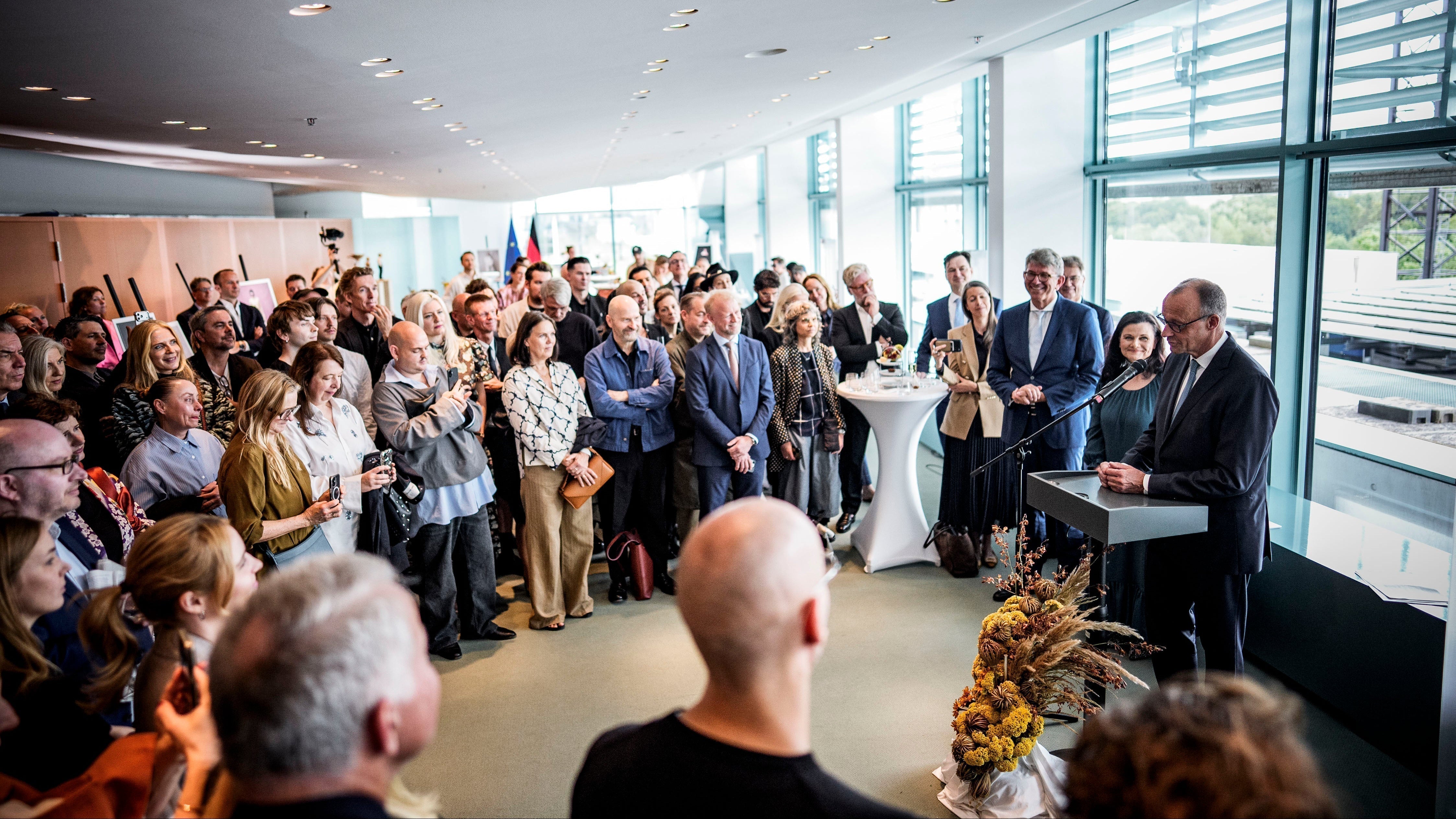
John Jahr Haus. Kurfürstenstraße 72-74. 10787 Berlin - July 2nd 2026You must Create is an interactive crowd performance that brings the design process out of the atelier and into a shared space. Within the framework of RAUM.Berlin, a place emerges where the focus is not on observing, but on making.
Exhibit
exhibit: you must create
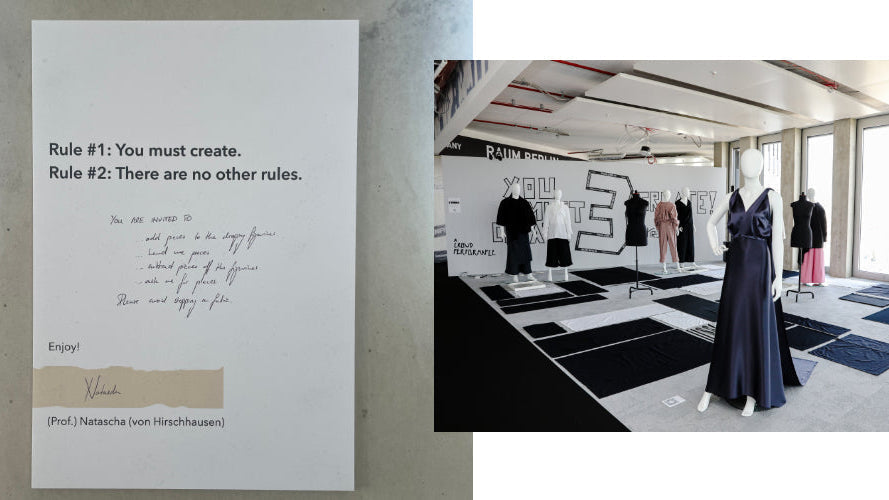
2026. performance with 81 square cotton pieces and 4 draping figurines.The room is filled with fabric pieces. 81 finished pieces are graphically laid on the floor leaving the view onto Berlin unobstructed from the 16th floor. Alongside a 10 look collection four empty draping figurines are placed in the room. Visitors of the exhibit are invited to pick up the fabric pieces, which have buttons and buttonholes in order to drape them on the figurines.
Co-design is not a buzzword here — it's a serious question: Who gets to think form? Who decides how clothing is made, and for whom? Natascha von Hirschhausen's work has spent years questioning the basic assumptions of the fashion industry: sizing, gender, production, time cycles. You must Create opens up that process — and makes the audience part of the answer.
The crowd performance treats the body as starting point and measure. Function and the inner logic of the material determine form. In deliberate resistance to overproduction and trend, something rarer takes shape: design thought together.
exhibit: the pattern sketch
2025. Pencil on paper scrap. 29x21cmIn the frame you see a rough sketch of a zero-waste pattern. This shows how our zero-waste patterns are constructed. It also reveals part of our process. Before we test patterns we create these little scribbles to come up with new concepts for the zero-waste design approach.
Zero-waste patterns work like jigsaw puzzles — one where every single piece is designed to fit precisely against the next, leaving almost nothing between them. A puzzle has to be thought as a whole from the very beginning. You cannot design the pieces independently and hope they will fit together at the end. This is where the real challenge — and the real craft — lies.
We create all our patterns in-house. The boundaries of the zero waste design is challenge and guide at the same time. While it is a labour intesive process that requieres a lot of dedication and time, we couldn’t imagine to work differently, because we value resources enough to spent time to get it right.
This approach is not only the refusal to waste resources. For us it also opens a new path of creation. By changing the way we perceive patterns, we are searching for a new way to create. It is about avoiding waste and coming up with unique, innovative designs. The constraint becomes the origin of new form.
exhibit: the evidence
2025. cotton pieces on cotton canvas. 27x27cmIn the frame you see all off-cuts of the white blouse on the mannequin. Zero-waste design is a technique. 0 and 100 are mathematical numbers. In order to show the meaning of "zero-waste design" we preserve every little thread and offcut of every garment we design as "evidence" and to make sure, that the leftovers are under 1% per design.
Every design on the website also features a picture of the correlating evidence bags. Displaying transparently the leftovers we have per design. In our design process during the sampling all clippings are wight in comparison to the garments. This way we can determine the total waste of our designs and ensure, that the textile waste is less than 1%.
In this evidence frame you see what the content of one evidence bag may look like.
exhibit: the earring
2018. cotton pieces on silver string. 3x8cmThe earring you see in the frame are the off-cuts of the pantsuit on the mannequin.
Telling a story about waste is hard. First, no one can see it. The waste of the fashion industry is hidden for the Western customers, even though the textile waste fills entire landscapes in the global south ruining entire ecosystems and economies. Because this waste is invisible to most consumers talking about textile waste is a ghost story, which leads us to...
... second: talking about waste is not pleasant. As humans, we gravitate towards positive stories, and talking about waste colonialism is everything but positive. How much would you like to indulge in a new designer piece after hearing about burning landfills in Ghana?
Third, as a zero-waste label, we are not event causing the cutting-waste, that we address. The only ones talking about textile waste, are the ones that are trying to avoid it. A power inbalance, that you can find through out more sustainable design.
This earring is an artefact of change. It tells us how design can be at the center of inspiring positive change and avoiding waste in the first place, while sharing information about the problems within the fashion industry. The off-cuts of this pants suit are less than 1% of its entire fabric. The little pieces that are left are sewn into this earring and thous telling a story of changing the rules of fashion.
exhibit: the origin
1856/2026. Organic and fair cotton. 30x30cmIn this frame you see a piece of organic and fair cotton and the very first sketch of our logo scribbled in 2016. The origin is the name of this pieces and it is the origin in many forms.
Material as origin of change: With our work we want to create systemic change, going down to the very source of the problems within the fashion industry. Knowing and caring for the entire supply chain is one fundaments, that we are building on. Jil Sander once said "The luxury lies within the choice of material." For us the luxury is to know every step and to rebuild the system based on strict ecological and social standards throughout the entire value chain.
Material as origin of my work: From the beginning in 2016 on we were honoured to have an exceptional partner in COTONEA. The company is working on building future-proof value chains based on social and ecological sustainability since 1856. COTONEA`s cotton is IVN Best, GOTS and Fair for Life certified, meaning it is audited along the entire supply chain by independent third parties.
Material as the origin of design: Every fabric has a character. Design has to stay true to this character or has to mold it very cautiously. The way the material falls or holds up shape, the structure, the colour, the hue, the yarns brings its own story and its the designers job to listen in order to find the form. Natascha's process begins there: By listening what the material wants to be and following it into form. In this exhibition you are invited to experience the materials yourself. Touch and feel the difference between poplin, cretonne, satin and kattun. The rawer feel of cotton again the soft, elegant feel of pima cotton. The more voluminous drape of poplin against the soft flow of Kattun. You must create.
exhibit: the showpiece
2026. 3 silk pieces with stone-nut buttons. 30x300cm. 30x300cm. 120x120cm.Three silk pieces are placed on the floor graphically along side the 81 cotton pieces. Quietly Natascha takes them off the floor and drapes them onto the last, the 10. empty mannequin in order to complete the collection, whilst showcasing the concept of the crowd-performance. Three abstract pieces become an evening gown.
The multi-dress embodies the underlying idea of the whole exhibit. Visitors are invited to do the same with the cotton pieces laid out on the floor. They work on the same principle: buttons, buttonholes and gatherings, ready to be assembled. Pick one up. Drape it. Create together.
In addition the dress tells a story of versatility. The dress can be worn for a lifetime and yet be different everytime. A multi-dress.
exhibit: 1 + 1 = 3
2023/2026. Felt tip on paper. 13x18cm.Three mannequins stand in the room. One wears a skirt. One wears a jacket. The third wears a coat. The coat is the skirt and jacket combined. Three designs. One garment.
In mathematics, 1+1=2. The answer is fixed. Design does not work that way. A coat can be a skirt and a jacket. The number of looks depends on how the garment is worn. Hence 1+1=3.
Good design can break rules, and hand that ability to the wearer. A single piece, worn differently, becomes a new design. Variation is a choice the design has created room for. This isn't just one thought-out design, it is a a way of thinking, that is always looking to create value. To create something more than 1+1=2 in any decision.
exhibit: aftermath
2026. 4 AI renderings. jpeg.The presentation YOU MUST CREATE and its outcomes raise a series of questions that the work does not seek to resolve, only to hold open:
Does this dress exist? Who is its creator? What is the value of a dress that cannot be bought? What, in fact, is creation — and what if it did not end with fashion week, but began there? What if fashion were inclusive rather than exclusive? Can one design be more, than one design? Can design break the math?
The final garments, still on their dress forms from the crowd performance, were photographed and then rendered onto models with the help of AI to make the outcome visible — a way of giving form to work that resists a single, finished silhouette. These renderings were then morphed with footage from the performance itself, so that the resulting images carry a trace of the process they came from: not a static result, but a sense of creation still in motion.


Thank you
You must Create took place within the context of RAUM.Berlin. An event by Fashion Council Germany, supported by the Federal Ministry for Economic Affairs and Energy (aufgrund eines Beschlusses des Deutschen Bundestages) and is supported by our trusted partner cotonea. Special Thanks to Knopf Budke and Mediadesign Hochschule Berlin for supporting this project.